
Feasting Day
What we carry into the dark

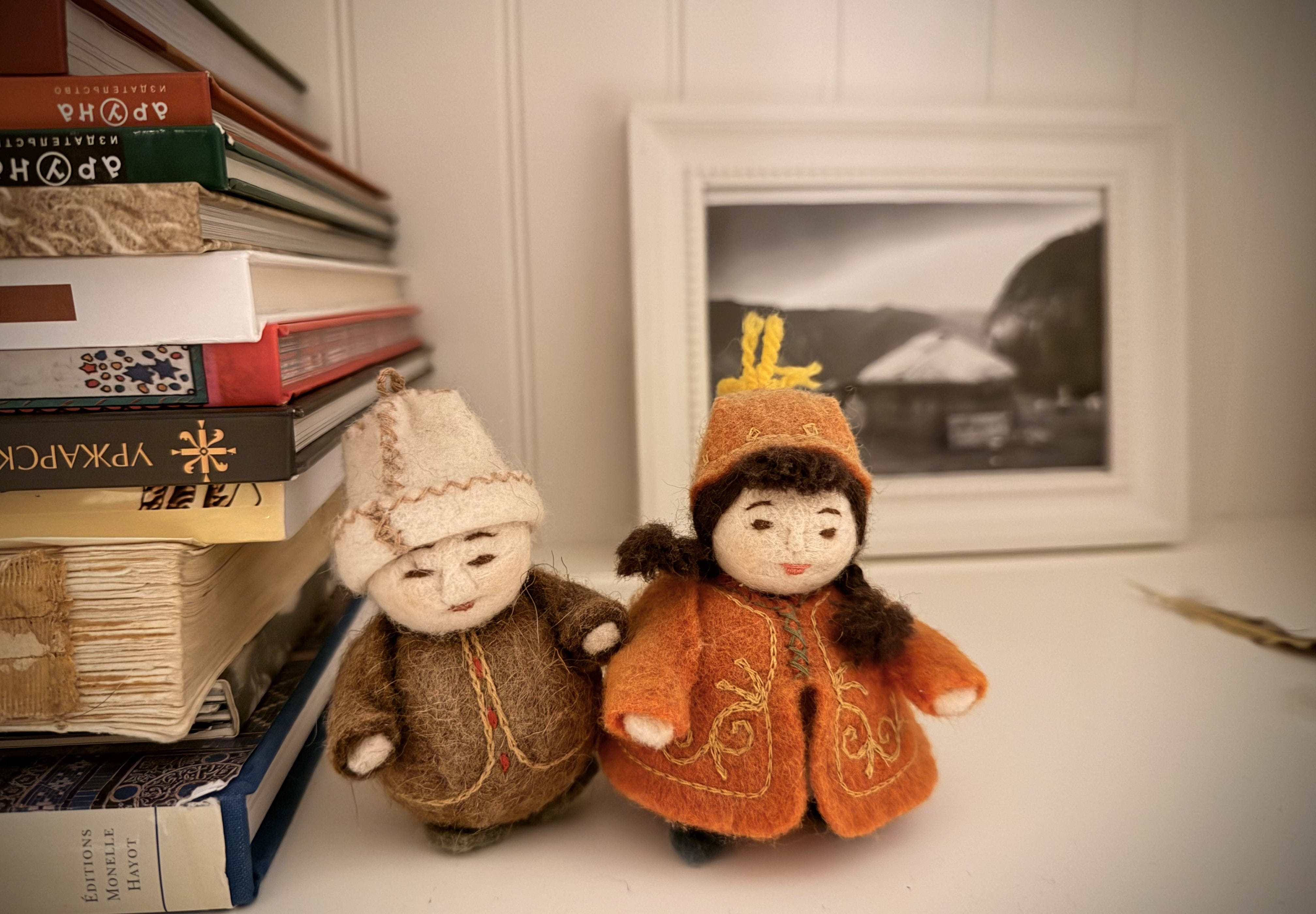
“Hi Mommy, look - I am ready!”
By the time I came back from walking the dogs, my kids had packed their old preschool backpacks, the ones with unicorns and superheroes, and leaned them against the basement door.
“Okay. What’s in there?”
Make-up, notebooks, books, stuffies - lots of stuffies. So many stuffies, I had to send at least a dozen back to their rooms.
The tornado warning in DC area was in effect since the day before, and kids were sent home early from school to avoid the calamity. Everyone was eager to descend into the basement when the wind picked up and the light started flickering.
I went again through their doomsday supplies. My son packed pajamas, socks, and a rather large but cozy throw. My daughter packed a sleeping mask, a notebook, pens and pencils. Both had water bottles and flashlights. She put the puffy backpack on her back, and in her hands held a doll that wasn’t even a toy, but a decoration from her room. It was a realistic, Barbie-type doll with long black braids, dressed in traditional Kazakh clothing. I brought it from Almaty the last time I went home.
“You brought the Kazakh Princess?” I was surprised.
“I didn’t want to leave her there, in case our house gets destroyed.”
Of all the things she could be worried about, I did not expect this to be her choice.
I heard my mom talking in my head and before I could stop it, the words spilled out of my mouth.
“That’s no surprise. Every Kazakh girl has a fairy great-grand-grand-grand-grandma watching over her. This is why you picked this doll with you. You are right, she will keep you safe.”
My husband and I spread the tea lights along the wall in the basement in case the power goes off. My kids and I pile up on the guest bed. It is dark, and the bed is tight for the three of us. Before I could do anything to prevent it, the kids are wide awake, pushing each other and giggling, and I am snapping selfies of our flattened-by-grins, phone-flash faces.
Soon it gets dark and quiet.
I hear their paced breathing. It puts me in the state of acute peace. Acute peace. We are safe here in the darkness of a cave. I am a cave momma with my cave babies.
The night we tried to move our son, three months old then, to his own room, my husband and I realized the ‘cry-it-out’ method was not for us. We brought our baby back to our bedroom, placed him right between us and fell asleep happily, never to entertain the idea of sleep training again.
I’m a cave momma. I am a cave momma. The cave momma cuddles her baby tightly in her arms. The cave momma keeps her baby safe. Why would a cave momma put her baby to the other side of the cave, alone, in the dark? The cave momma keeps her baby safe.
I still could not fall asleep. Something stirred in me that felt like excitement. A distant memory started unfurling, an older memory than even the one that the cave momma had.
“Let’s play a Feasting Day!”
“Yay - a Feasting Day!”
“A Feasting Day - hooray!”
Dimka Z. was the one who came up with the Feasting Day idea, of that we were certain. We is me and Yul’ka, the two of us is all that was left of our childhood posse. Us being the only ones who reached adulthood in our hometown and stayed in touch. Until I left for the US.
And now all of us scatter back to our apartments, and bring whatever food we can find. We bring flashlights too, but also matches and candles.
It might not be easy to grasp, as communities like these don’t exist in the US, but in other parts of the world several housing units built around a shared green space are actually common. So this was ours - three small two-story buildings, in an L-shape closed off on one side by a fence separating us from an abandoned construction site of a Museum of Lenin, and on another - by a row of garages and woodsheds belonging to the members of the ‘dvor’ community. In the middle, there were little gardens with lilac and fruit trees, and a play area on my side of the dvor. Altogether, the space was home to about forty families.
We chose Yulka’s woodshed for our Feasting Day, maybe because she was the oldest and her parents trusted her with the key. All in all, we went in with whatever we had managed to scavenge from our homes.
In the woodshed, her family stored wood. But also bikes, tools and other stuff. In the ground, there was a door that opened to a cellar.
“This is perfect. This is exactly the place for the Feasting Day!”
We descend into a cold and humid cellar. Surrounded by rows and rows of jars of pickled vegetables, we sit on the ground in a circle, secure our lights so as to free up our hands and start unwrapping and presenting the food for a Feast.
Candy, bread and lard, smoked sausages, hardboiled eggs. We ate them in the dark in a solemn silence. We were so quiet during the Feasting Days, that we went through at least a full summer of them before adults found out what we were doing and where.
The day we got busted was the day we did not have flashlights on us and decided to burn candles. When you’re ten or twelve, once you start playing with matches, you naturally start setting things on fire.
“What are you doing there? You’re going to burn the whole neighborhood down—get out of there this instant!”
Andrei’s grandmother was the one to catch us. She was always the one. When we found a dog with a whole litter of puppies and built a house for them in one of the woodsheds, she was the one who called the dog pound. When we found that someone left the entrance to the rooftop unlocked and we all climbed up to sunbathe, enjoying the view of the neighborhood, she told on us to the one mean neighbor who started throwing apples to get us down. I remember running on a sloped roof in panic, slate sliding under my feet. It was always her, the same woman who taunted me for not speaking my native Kazakh.
That was the end of the Feasting Days for us.
I never thought of this until I got much older. Little girls play with dolls to prepare for motherhood. Little boys play war to prepare for what society expected men to do for millennia - protect their homeland. Both little girls and little boys play hiding to practice the skill that kept them alive since time immemorial. But there is more to Feasting Days than that.
When two years later the Soviet Union collapsed, about 400 000 Soviet Jews and their families migrated just during the first year. Dimka’s family among them.
Was it a coincidence he was the one to come up with the idea of the Feasting Day? Was it an innocent child play, a prehistoric game that hunter-gatherers played to practice survival skills? Or did it come from stories told in his family, something older spilling out into our game?
Darkness. Shelter. Safety.
I put my hand into my daughter’s pink backpack adorned with unicorns and rainbows. I get out a notebook and pens. She loves writing. But the thought of her writing in her notebook in the darkness of the basement makes me shiver.
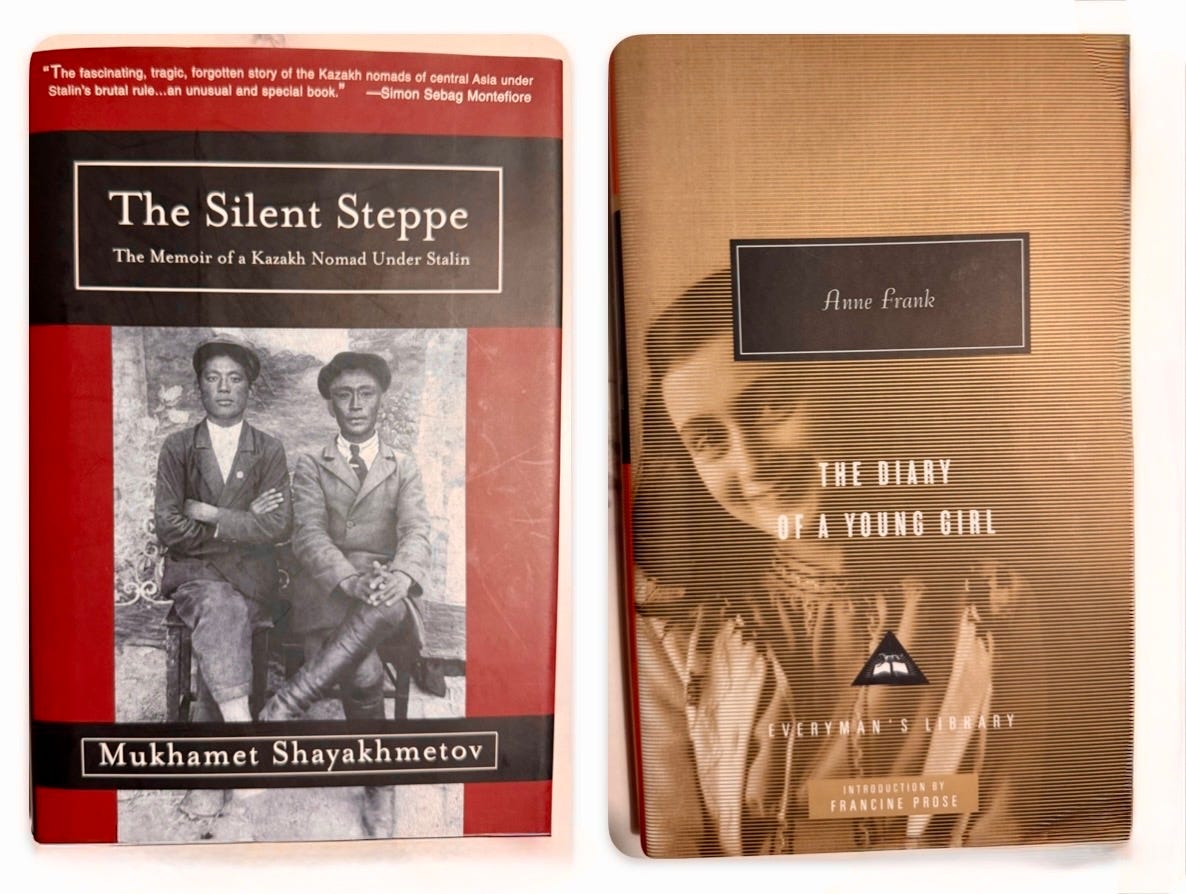
I bought The Diary of a Young Girl by Anne Frank some years ago when putting together my own collection of the popular Everyman’s Library set. But I still haven’t found the heart to read it. Is there ever a good time to read Anne Frank? I am scared of the effect it might have on me. Especially now, in 2026.
There is another strange stir in my heart that the sudden darkness evokes.
Power outages were frequent in my childhood and on the occasions when the whole neighborhood would go dark, there was always a sudden peace in our house. Dad would light candles and all of a sudden start talking in a whisper, as by some ancient instinct.
Those years, after grandma died, dad was becoming unpredictable. Sometimes he had unprovoked anxiety attacks and would lash out at us, shouting, “We’ll have nothing to eat soon! Don’t you understand? We’ll be broke! We’ll starve! Not even a penny for bread!”
At the time, it felt irrational. We were not starving. There was food in the house. There was always bread. But a generations-old fear does not require justification. It is not about probability, but the fact that it already happened once. If something happened once, it can happen again. The memory screams, “we’ll all starve.” The memory protests: “never again.”
It took me years to understand that this fear did not begin with him.
In Kazakhstan, there is a word—Asharshylyk—for the famine of the 1930s, when hunger was not a possibility but a certainty, when entire families disappeared, when having or not having bread was the only thing that mattered.
“The educated world knows little—if anything at all—of the suffering of the nomadic people of Central Asia under the rule of Stalin…” In his memoir, The Silent Steppe, Mukhamet Shayakhmetov begins with that insistence on what is not known.
“...and the policy of collectivization launched in 1929: least of all, of Kazakhs whose immemorial habitat comprised that wide swath of steppe-land from the Eastern shore of the Caspian to the great Tian Shan range of mountains which, with the Altai range to the north, forms the frontier of Kazakh territory, and today’s Kazakhstan.”
I have had this book for years, sitting on the same mental shelf as The Diary of a Young Girl by Anne Frank - another book, avoided. I am not sure what it will do to me if I read it. Whether it will clarify something, or undo something. Whether it will give shape to what I have only felt in fragments, or make it harder to keep those fragments contained. Writing this now, I realize that the hesitation is part of the inheritance too- the instinct to look away, to delay, to leave certain histories untouched.
“Blood carries memories, and today’s Kazakhs are, to a man and a woman, the descendants of that remnant who somehow survived the privations of the appalling period this book covers.”
An estimated 1 to 1.5 million Kazakhs died during those years—roughly a quarter to a third of the population, while many others fled, never to return.
But this was not something we grew up knowing.
No one explained it to us in school. No one sat us down and said: this is what happened. Not about Asharshylyk in Kazakhstan, or the Holodomor in Ukraine, or even the Holocaust. These things were not spoken about. If you did not hear it in your own family, you did not know.
We did not know what it meant that Dimka was Jewish. It was just a word. We did not know what histories stood behind it, or why his family would decide to leave.
And yet he was the one who came up with the Feasting Days. Darkness. Shelter. Food gathered and guarded. At the time, it was a game.
It is easy to think that children invent these things on their own. That it is instinct, imagination, play. But sometimes play is not invention. Sometimes it is memory, passed down without words.
And sometimes, it is words - “we’ll starve,” “we’ll perish” - passed down without history, without context. It is up to us to untie the knots, to excavate the meaning, to unpack what we bring to the feast of life - what we share, what we should share, and what we leave untouched.
The wind died down. The lights stayed on.
I gently touch my kids’ tiny shoulders to wake them up and send them back to their rooms.
By morning, everything was as it had been. Breakfast, school, work.
The backpacks stayed by the basement door. The Kazakh princess was back on the shelf.
I make a commitment to read both books, through the discomfort and heartache they may bring.
Lovely piece, Alua! Your storytelling is getting better - I really like the weaving of different perspectives and stories within the fabric of the tornado risk last week and your family’s preparation for it.
I really enjoyed this story. How lucky I have been to never have seen war or famine. I loved The Diary of Anne Frank. I was 9 or 10 when I read it. It may bring things up but ultimately, it is the story of kindness. There is a through line of kindness in life, amazingly.